|
News National Opera
|
 THE Articles THE Articles |
| News |
| Other articles |
|
News other categories
|
| Opere din Romania |
Opera Națională București
Opera Comică pentru Copii București
Teatrul Național de Operetă și Muzical București
Opera Română Craiova
Opera din Brașov
Teatrul National de Opera si Balet Constanta
Teatrul Național de Operă și Operetă din Galați
Teatrul Național de Operă și Balet Chișinău
Opera Națională Română Iași
Opera Nationala Română Cluj-Napoca
Opera Națională Română Timișoara
Opera Maghiară din Cluj-Napoca
Teatrul de Balet Sibiu
Festivalul Opera Nights - Hunedoara, Deva
Teatrul Muzical Ambasadorii București
Teatrul Stela Popescu București
Opera Vox Cluj-Napoca
Sala Palatului din București
Festivalul Internațional George Enescu București
Teatrul Acting Dream București
Theater du Soleil Entertainment
Grand Cinema Digiplex Băneasa
Teatrul de Revistă Constantin Tănase București
| Opere din străinătate |
Budapesta Opera
Hedeland Opera
London English National Opera
London Royal Opera House
Milano Teatro alla Scala
Munchen Bayerische StaatsOper
New York Metropolitan Opera
Oslo Operaen
Roma Teatro dell Opera
Ruse Drjavna Opera
Sofia Opera House
Stockholm Royal Swedish Opera
Torre del Lago Puccini
Varna Opera House
Viena StaatsOper
Viena VolksOper
| Mari artiști români |
Angela Gheorghiu
Cristian Mihăilescu
Elena Moșuc
Felicia Filip
Haricleea Darclee
Ionuț Pascu
Leontina Văduva
Lucian Petrean
Ludovic Spiess
Teodor Ilincăi
| Stiri teatru |
| Spectacole de operă |
Aida
Asa fac toate (Cosi fan tutte)
Boema
Bărbierul din Sevilia
Carmen
Cavalleria rusticana și Paiațe
Clemența lui Tito
Don Giovanni
Don Pasquale
Elixirul dragostei
Flautul fermecat
Freischutz
Germanicul (Il Germanico)
Gianni Schicchi
Idomeneo, Regele Cretei
MacBeth
Madama Butterfly
Manon Lescaut
Mikado
Nabucco
Norma
Nunta lui Figaro
Orfeu în infern
Paiațe
Peer Gynt
Rapirea din Serai
Rigoletto
Romeo și Julieta de Charles Gounod
Samson și Dalila
Simone Boccanerra
Tosca
Traviata
Tripticul (Il trittico)
Trubadurul (Il trovatore)
Turandot
Werther
| Spectacole de opereta si muzical |
Doctor Jivago
Țara surâsului
Femeia, eterna poveste
Frozen
Frumoasa și Bestia
Liliacul
Logodnicul din lună
My Fair Lady
Notre Dame de Paris
Rebecca
Sânge vienez
Silvia
Sunetul muzicii
Vaduva veselă
Zaraza
| Spectacole de balet |
Don Quijote
Frumoasa din Padurea Adormita
Giselle
Lacul lebedelor
Marco Spada
Medea
Spargatorul de nuci
Zorba grecul
| Concerte de muzica simfonica |
Recviem de Mozart
Recviem de Verdi
| Teatre Muntenia (fără București) |
Teatrul Alexandru Davila Pitești
| Teatre Oltenia |
| Teatre Republica Moldova |
| Teatre Banat, Crișana, Maramureș |
| Teatre Oltenia |
| Teatre Dobrogea |
Teatrul de Stat din Constanța
| Teatre Moldova |
| Teatre Ardeal |
| Teatre București |
| Teatre Oltenia |
| Teatre București |
Teatrul Țăndărică București
| Teatre Moldova |
| Teatre București |
| Teatre Banat, Crișana, Maramureș |
| Teatre Oltenia |
| Teatre Muntenia (fără București) |
| Teatre București |
| Teatre Oltenia |
Teatrul Național Craiova
| Teatre Republica Moldova |
| Teatre București |
| Teatre Ardeal |
| Teatre Republica Moldova |
| Teatre Ardeal |
| Teatre Banat, Crișana, Maramureș |
| Teatre Moldova |
| Teatre București |
Teatrul Odeon București
| Teatre Moldova |
| Teatre Republica Moldova |
| Teatre Ardeal |
| Teatre Moldova |
| Teatre Muntenia (fără București) |
Teatrul Tony Bulandra Târgoviște
Teatrul Tudor Vianu Giurgiu
| Teatre București |
| Teatre Oltenia |
Boema belissima at the Oslo Opera
[ Author Adrian Trasca ]
 A hospital room. On the sides and above are the walls and ceiling made of white cardboard. On the right on hospital bed a young ladies lies. Shes wearing a white hospital dress with blue spots and she’s bold. Doctors and nurses around her. On a wall above the hospital room, on a big screen are projected, with a fluorescent green, the EKG of her heart. This is the only sound heard in all of National Oslo Opera. A heartbeat. And another. And another. And so on. Then the continuous squeaky sound that tells that her heart stopped. A hospital room. On the sides and above are the walls and ceiling made of white cardboard. On the right on hospital bed a young ladies lies. Shes wearing a white hospital dress with blue spots and she’s bold. Doctors and nurses around her. On a wall above the hospital room, on a big screen are projected, with a fluorescent green, the EKG of her heart. This is the only sound heard in all of National Oslo Opera. A heartbeat. And another. And another. And so on. Then the continuous squeaky sound that tells that her heart stopped.The music starts. "Boheme" by Giacomo Puccini. The future Marcello is dressed in the blue clothes of a hospital attendant and washes the floor. The future Musette is an assistant. Appears of scene but doesn’t speak. The four friends shiver and set on fire Rodolfo s manuscript. The fire is expending easily on the room walls and on the sides, creating the sensation that will envelop the whole auditorium! Fantastic technical realization! 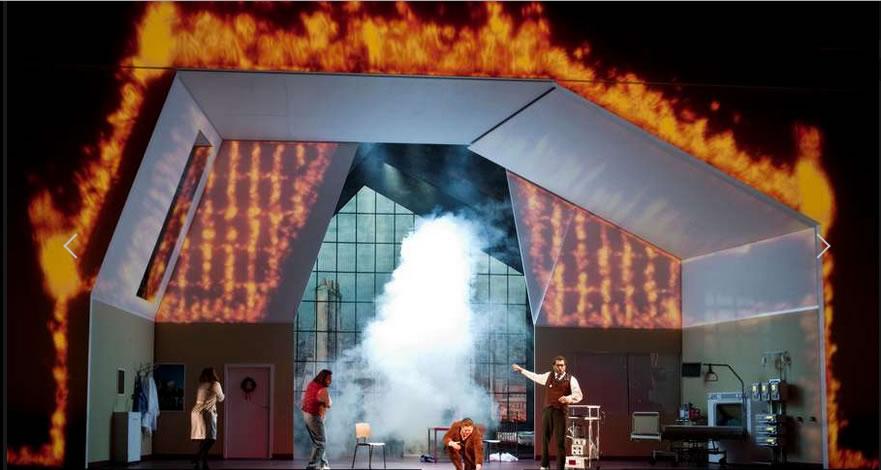 The set is opening - the walls rooms are moved towards the sides. In the back a castle can be seen. The hospital bed is still there, unmoved. Rodolfo is looking at it sometimes, heartbreaking. Benoit. He is dressed in a dark green wrapper, has a beak, aquiline nose, white on his face and his eyes painted with black. He is not humble at all, on contrary, frightening. Further my sensation will be confirmed. “Per esempio… mia moglia! " the phrase and actions of the Bohemians should make Benoit humble. But he takes of his cap, his bold, ugly and defiant. He leaves. 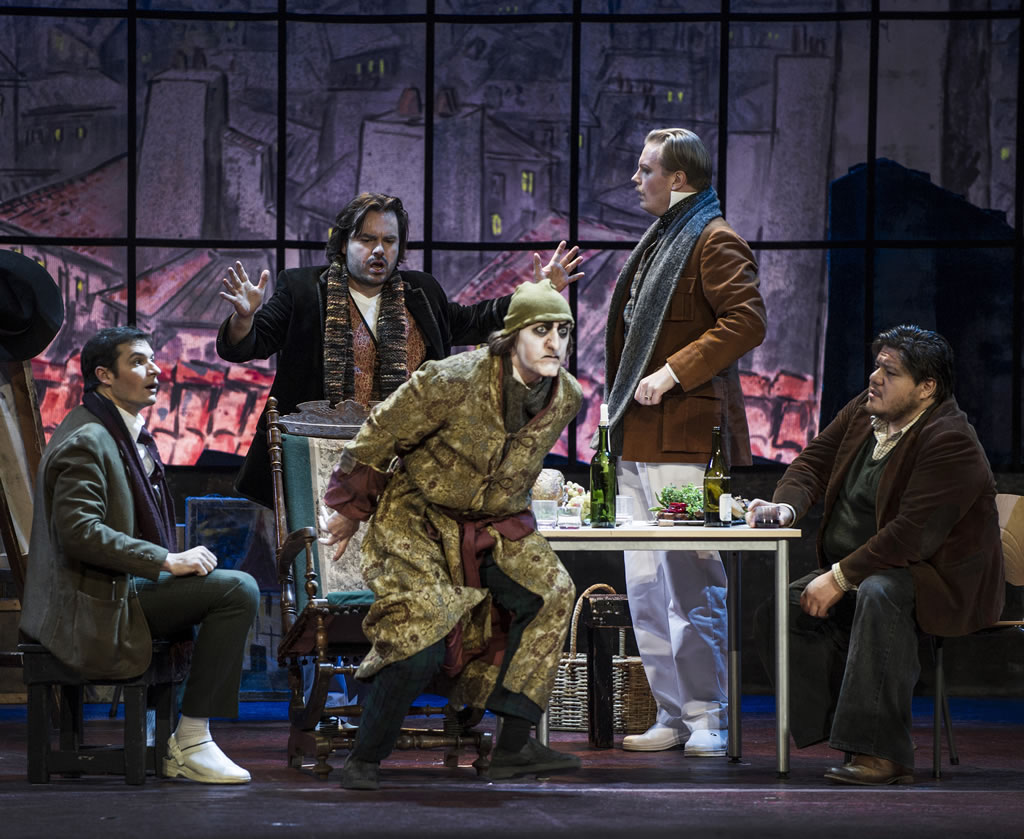 The four are preparing to leave, as well, to the city. Rodolfo remains, knowing him as he is, but the others are getting into their white wrappers before they leave. Mimi appears. She’s not to pretty and her voice isn’t exceling. Rodolfo undresses her; she remains in her hospital cloth and she’s …bold! The scene rebecame a hospital. The two discuss but the atmosphere isn’t the classic one, of pure love, everywhere death can be felt. Fulminant moment. Mimi lies on the hospital bed, with the eyes closed, she’s dead. Rodolfo hold her hand. "Che geee-li-daa manina! Se la lasci riscaldar". Mimi is dead and Rodolfo sings and sings and sings…. "Poiché Poiché vi ha preso stanza la speeraaanza! “ Mimi is rising! 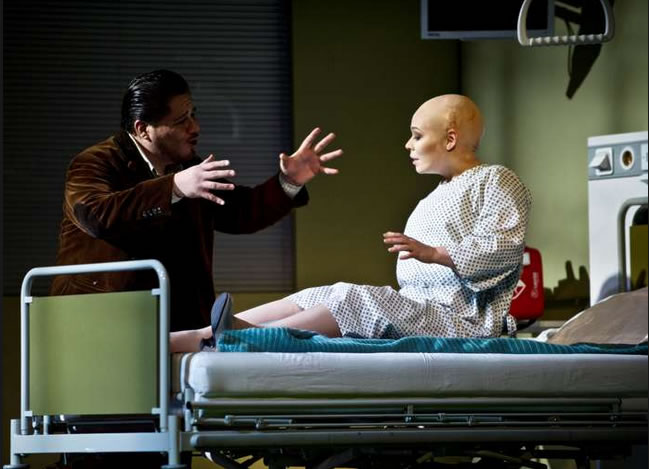 Her aria. Mimi sings without voice inflexions. In the left of the room, in an upper window, a light appears. "Ma quando vien lo sgelo / But when the thawing comes" the light is getting stronger "I primo sole è mio / il primo bacio dell`aprile è mio! il primo sole è mio! “ ("The first Sun is mine / the first kiss of April is mine") the light is growing progressively hitting the apex. Rodolfo suffers when she sings. She goes in the corner of the room where a rose vase is. Touches it slowly and the petals fall! Mimi retreats frightened. 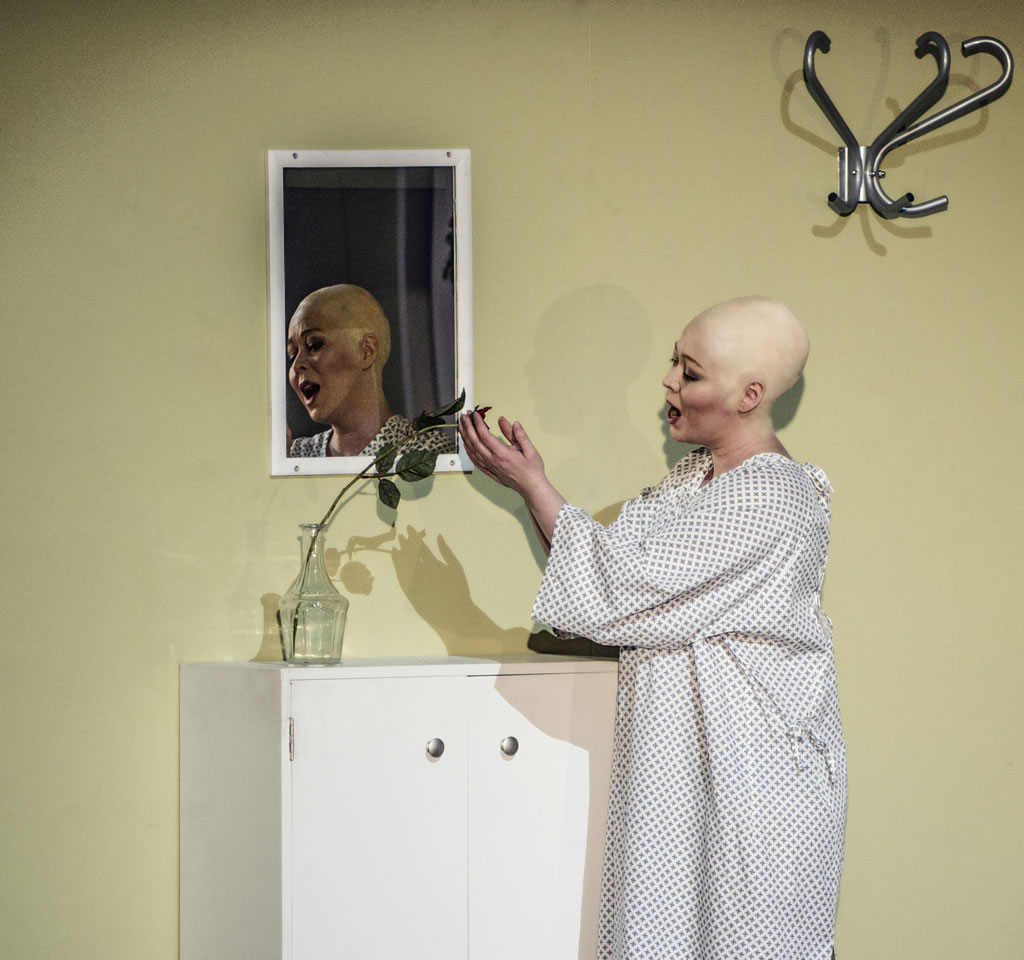 Towards the end of the aria the light disappears and Mimi is dressed in normal clothes. The three friends of Rodolfo, invite him in town, but appear at the window dressed in doctor clothes. "Non sono solo. Siamo in due." then "O suave fanciula" in a wave of steams at their feet, in the back at the window, "Momus" can be seen. People, some having sideburns like Ibsen, in which country we are, enters there when they leave the scene towards the end of the aria making way for act two. 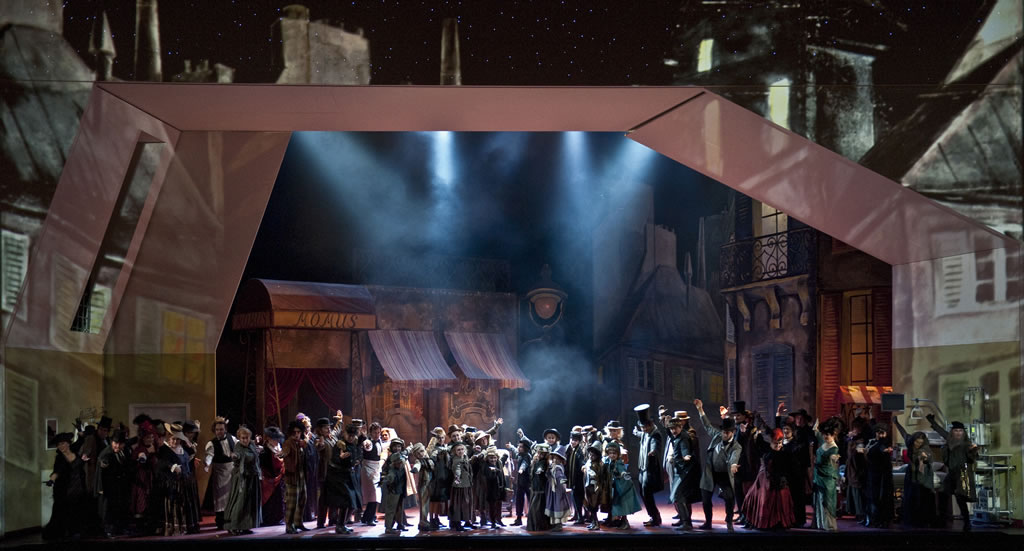 When those from the main roles sing, the people from “Momus" freeze. The hospital bed is still on the right although I initially thought that the organizers forgot, but child who wants “la tromba e il cavallin" asks for them from the hospital bed, dressed in a hospital shirt and bold. Mimi is terrified when she sees the child, so is Marcello and the rest when they see “la cuffietta rosa"! Musette appears. Surprise, Alcindoro is the same person who interpreted Benoit and his presence is not for saving funds. He’s dressed in a white tie, not humble like the original version, cinic and has Count Dracula allure. "Quando men vo"... 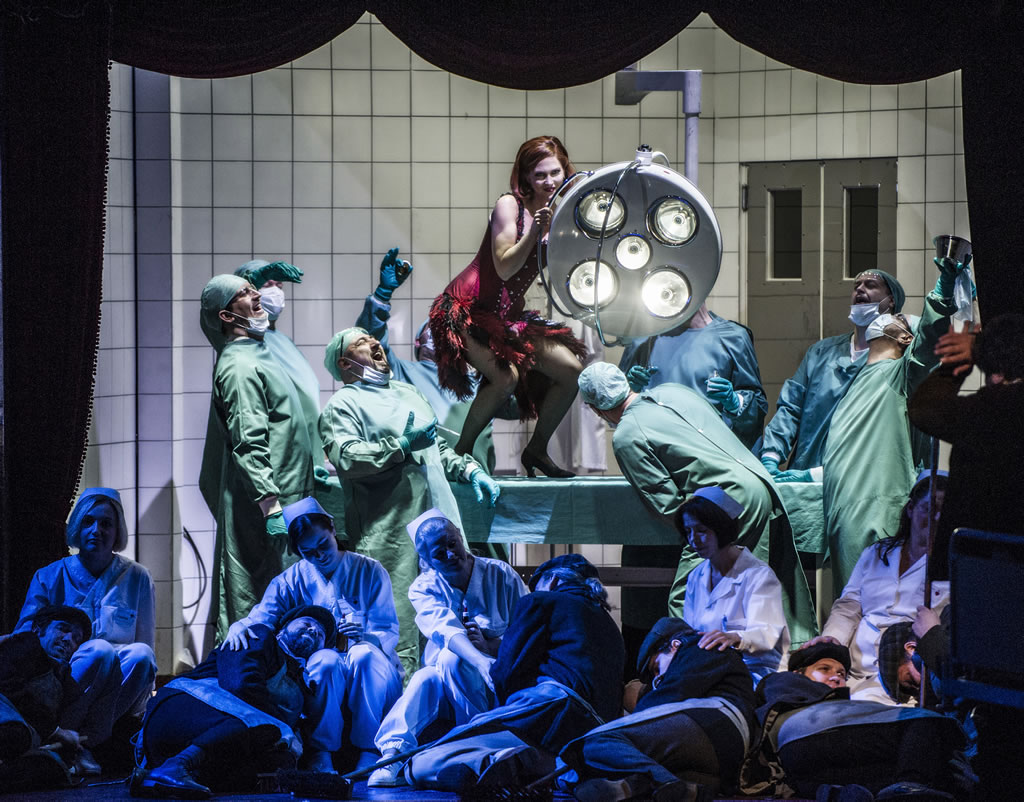 The four are holding their stomachs and Alcindoro is jubilating, far from being disturbed by display of his partner. At the end of the aria, Alcindoro is climbed on the table with his cape loose, smiling and dominating the moment. All the people from “Momus" take their wigs down and remain bold, including the children. Mimi faints. Next is the parade. The public (on the scene) is still bold. Alcindoro is the general, stepping just like at the army, takes Mimi, parades and exits the scene with her! The set-up rebecames a hospital room, Rodolfo is holding his head in his hands and suffers. The third act. Hospital room. Alcindoro-Dracula appears as stretcher bearer. His in a brown suit, just like Rodolfo! With a white face and cynic. Rodolfo suffers. The sweepers are coming through the hospital room door (located in the back of the scene/ room). The set-up is coming apart, the milkmaids appear, which are… nurses. The set-up is rotating and the entrance of a hospital appears on which is written… “Oncologie"! Around are platters, nurses, people in wheelchairs or toggle. Marcello is in blue hospital clothes. Alcindoro-Dracula is on the bed. Rodolfo come to fight him. AlcinDracula copies some gesture from other opera parts, distinguishable only to who know very well the opera. Cough instead of Mimibefore replying "Che tosse! "of Marcello and sleeps on the bench instead of Rodolfo before being called outside. Mimi is "hiden" on the hospital bed to not be seen by Rodolfo. Rodolfo: "Dunque è proprio finita? Te ne vai, te ne vai, la mia piccina?! Addio, sogni d`amor!..." Mimì: "Addio, dolce svegliare alla mattina! " Rodolfo: "Addio, sognante vita..." Buttttt….. In the middle of the scene Mimi sings, and on the bed Mimi is dead, towards which Rodolfo sings! Incredible moment! Fourth act. The set-up is changed. They return to the hospital room, but now the back wall is changed to window through which the crowd looks at what is going on. In the center of the crowd is AlcinDracula dressed as a doctor with a violin. Rodolfo and Marcello see him and got scared. When the four friends gather and talk and in the original version, laugh, the laughing is made by the crowd! When the four invite each other to dance, AlcinDracula comes, climbs a ladder and sings. Nothing is like the original version, all is cynic. Musette appears and tells that Mimi is on the stairs and can’t climb them. But in the meantime Mimi is on the stage, and while Musette tells the story, AlcinDracula plays the violin and plays and plays and plays till Mimi lies on the floor. Then he look, smiling, at Rodolfo and leaves arrogant in the back from where the action continues. 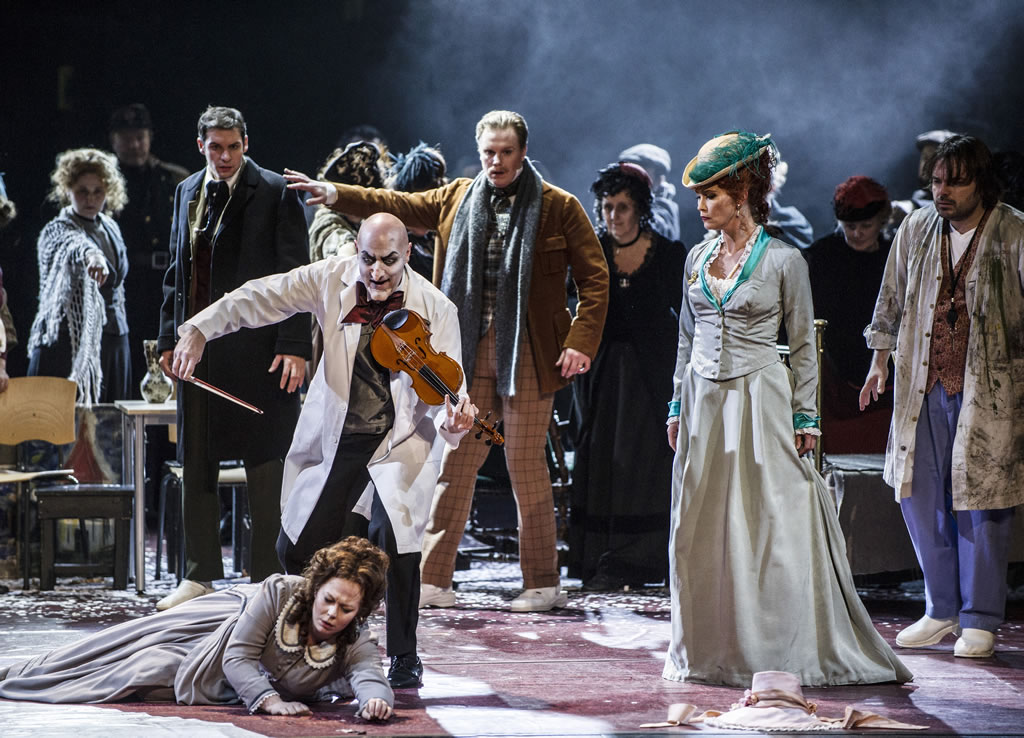 Rodolfo and Mimi remain alone in the middle of the scene. Sings and Mimi is looking often at the hospital bed located in the right part of the scene. A little while later, Colline, Musette and Marcello show up, their doctors and Rodolfo the patient! Death of Mimi. First the real one. Mimi sings and, in the moment of death, remains standing on her feet in the middle of the scene, while Rodolfo is looking at her. A few moments later, Rodolfo turns his back. “Coraggio! " says Marcello and Rodolfo turns facing towards the middle of the scene. Mimi is gone from there. I do not like modern set-up. This one conquered the hole of me! On 29 January 2014, the spectacle date, marked 8 years since the death of Master Ludovic Spiess (the great tenor, who in 1960 was considered number 1 worldwide), whose favorite role was Rodolfo in “Boheme". A far thought, from Oslo, further to the sky. "Che gelida manina! Se la lasci riscaldar." Music: Giacomo Puccini Text book: Giuseppe Giacosa Rodolfo: Daniel Johansson Mimi: Mariann Fjeld Olsen Marcello: Yngve André Søberg Musetta: Nina Gavrok Døden/Benoit/Parpignol/Alcindoro/toller: Svein Erik Sagbraten Schaunard: Havard Stensvold Colline: Petri Lindroos Directed by: Stefan Herheim Scenography and costumes: Heike Scheele Musical director: Kirill Karabits Lights: Anders Poll Drama: Alexander Meier-Dörzenbach About the spectacle on site-ul Opera from Oslo: http://operaen.no/en/Performances/La-Boheme/. |


Current mark: 9 (from 1 marks awarded) - Give a mark!
Other titles in the same category
30-09-2024: Aida storica 1913
"Aida" in Verona 100 + 1. A hundred emotions plus one, yours!
Arena di Verona, the most Italian place on Earth!
These are the slogans through which Arena di Verona has chosen this year, 2024, to promote the Opera Festiva ...
[ continuation ]
[ Author Adrian Trasca ]
From category THE Articles
21-09-2024: Aida shines brightly at the Arena di Verona
The Arena di Verona is also presenting a modern version of Aida, in addition to the old but wonderful version from 1913. And it looks something like this!
The stage is tilted, and the floor is made of glass. In the center, a giant hand ...
[ continuation ]
[ Author Adrian Trasca ]
From category THE Articles
11-09-2024: Tosca a Verona 2024
Mario`s painting is huge, but... it`s on the floor, lying on its side. Mario doesn`t actually paint it, but "works" on some sketches. In the center of the stage you can see some huge shapes/objects, covered with black cloths. There are also two canno ...
[ continuation ]
[ Author Adrian Trasca ]
From category THE Articles
01-09-2024: “La boheme” at Arena di Verona
Arena di Verona. We arrive. We park. We get off. We take a few pictures with the Arena in the background, then ... a heavy rain starts! We take shelter under a tree. :-) I don`t think the show is happening anymore, but we can`t leave either, so we ju ...
[ continuation ]
[ Author Adrian Trasca ]
From category THE Articles
20-12-2023: Spoletta, symbol of Hungarian anti-communist resistance
Budapest Opera House was inaugurated in 1884 to be a competition for Vienna StaatsOper. It is localised in the center of the hungarian capital, just a few minutes behind St. Stefan cathedral, the bigest church of the city. In 2022 is was open again a ...
[ continuation ]
[ Author Adrian Trasca ]
From category THE Articles
| Under construction |


|
| Options |
| Recommended articles |
| Search |
| Articles authors |
| Translators |
| Opera links |
| Useful links |
| Monthly program |
| Romania operas map |
| Opera news cities |
| Website's maps |
| The website in Romania |
| The website in Europe |
| The website in Asia |
| The website in Africa |
| The website and Angela Gheorghiu |
| The website and Elena Mosuc |
| The website and Teodor Ilincai |




|
Articole OperaNationala.ro
|
OperaRail 2012
OperaRail 2013
OperaRail 2014
OperaRail 2015
OperaRail 2016
OperaRail 2017
OperaRail 2018
OperaRail 2019
OperaRail 2020
OperaRail 2021
OperaRail 2022
OperaRail 2023
OperaRail 2024
OperaRail 2025
OperaRail 2026
RomaniaRail 2015
Bilanțuri
Concerte de arii
Concerte de muzică simfonică
Piese de teatru
Tururi ghidate


